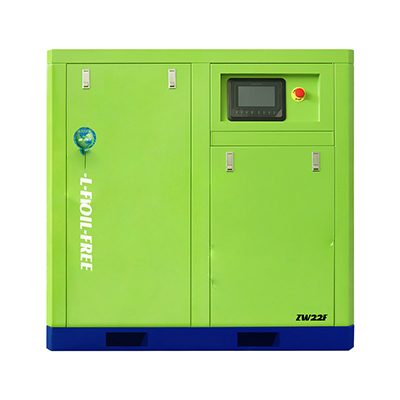
Energy-saving-design water-lubricated oil-free screw air compressor reduced consumption
News 2025-11-17
Energy-saving-design water-lubricated oil-free screw air compressor reduced consumption
High-efficiency architecture and operating principle
Energy-saving water-lubricated oil-free screw air compressors combine a dry compression chamber with a closed-loop water injection system that replaces traditional mineral oil. During operation, water absorbs compression heat, stabilizes discharge temperature, and seals the rotor clearances, which improves volumetric efficiency and reduces internal leakage. The screw profile is precisely engineered to maintain optimal rotor engagement at medium and high loads, cutting specific power consumption. Because there is no oil in the air end, downstream filtration is simplified and pressure drops are minimized, further lowering energy use and total lifecycle cost in demanding industrial environments.
Key performance advantages and energy-saving features
This compressor type delivers outstanding energy savings through variable-speed drives, intelligent load-unload control, and optimized cooling water circulation. The use of water as the lubricating and cooling medium allows near-isothermal compression, achieving high free air delivery at lower kilowatt input. Integrated sensors monitor temperature, pressure, and flow in real time, enabling precise matching of air supply to plant demand and preventing inefficient idling. The absence of oil eliminates the need for energy-intensive thermal oil removal, condensate treatment, and complex filter trains, while the reduced mechanical friction extends bearing life, lengthens service intervals, and cuts unplanned downtime, which directly improves overall plant productivity.
Industrial application scenarios and process benefits
Water-lubricated oil-free screw air compressors are widely adopted in sectors where product purity, safety, and regulatory compliance are critical. Typical applications include food and beverage packaging, pharmaceutical manufacturing, electronics assembly, textile production, automotive painting, and precision instrument fabrication. In these scenarios, 100 percent oil-free compressed air avoids product contamination, protects catalysts and membranes, and helps facilities meet stringent ISO 8573 air quality classes. Stable discharge pressure and low pulsation enhance the accuracy of pneumatic actuators, coating systems, and air knives, ensuring consistent product quality, reduced scrap rates, and tighter process control across continuous and batch production lines.
Environmental impact, cost control, and maintenance
The energy-saving design directly supports corporate sustainability goals by lowering CO2 emissions associated with electricity consumption. Water-based lubrication eliminates oil leaks and hazardous waste streams, simplifying environmental compliance and lowering disposal costs. Maintenance teams benefit from cleaner pipe networks, fewer filter replacements, and faster service tasks, as there is no need for oil changes or periodic oil analysis. Long-term operating cost is reduced through decreased energy bills, fewer spare parts, and improved system reliability. When integrated into a centralized compressed air station, these compressors can be combined with heat recovery systems to supply process hot water, boosting overall plant energy efficiency.
Common questions about energy-saving water-lubricated oil-free screw compressors
1. What industries benefit most?
They are ideal for food, pharmaceutical, electronics, and high-end manufacturing plants that require clean, oil-free air and stable long-term operating costs.
2. How does water lubrication reduce energy use?
Water absorbs heat, enables near-isothermal compression, lowers discharge temperature, and reduces internal losses, so the compressor delivers more air per kilowatt.
3. Is the compressed air really oil-free?
Yes, the design removes the need for lubricating oil in the compression chamber, helping users meet strict oil-free air standards and product safety requirements.