Permanent Magnet Air Compressor for Textile Mills – Consistent Pressure for Fabric Processing Machinery
News 2025-11-17
Permanent magnet air compressors are becoming a core utility in modern textile mills, where stable compressed air directly affects yarn quality, loom performance, and dyeing accuracy. From spinning and weaving to knitting and finishing, fabric processing machinery depends on consistent pressure to maintain precise tension, uniform airflow, and clean operating conditions. A permanent magnet compressor provides the efficiency and control that high‑volume textile production requires, while lowering lifecycle costs and supporting energy management targets.
Role of Compressed Air in Textile Applications
Compressed air drives a wide range of textile equipment, including air‑jet looms, pneumatic splicers, automatic winders, sizing machines, and air knives used in drying and cleaning. In these processes, even small pressure drops can cause broken yarns, unstable pick insertion, color deviation in dyeing, or surface defects on woven and knitted fabrics. Permanent magnet air compressors help maintain a constant pressure band for these sensitive operations, minimizing product variation and machine stoppages. Stable air quality and flow also reduce contamination, protecting fibers and finished fabrics from dust and oil carryover.
Performance Advantages of Permanent Magnet Technology
A permanent magnet compressor uses a high‑efficiency PM motor paired with variable speed regulation, allowing the machine to match air output precisely to textile mill demand. This configuration significantly cuts off‑load power, improves part‑load efficiency, and reduces energy costs, which are critical in 24/7 spinning and weaving operations. Low starting current lessens stress on electrical infrastructure, while improved power factor enhances system stability. The compact design, reduced vibration, and quieter operation create a more comfortable environment for mill workers and simplify integration into crowded production floors.
Consistent Pressure for Fabric Processing Machinery
Textile processes often run within tight pressure tolerances, especially high‑speed air‑jet looms and automated finishing lines. Permanent magnet air compressors deliver rapid response to demand fluctuations, keeping pressure stable during peak loads such as loom startup or simultaneous operation of multiple machines. Advanced control systems monitor discharge pressure, motor speed, and temperature, ensuring continuous operation under varying production plans. This consistency reduces end‑of‑line defects, improves fabric handfeel and dimensional stability, and supports higher machine utilization rates with fewer unplanned shutdowns.
System Integration, Maintenance, and Energy Management
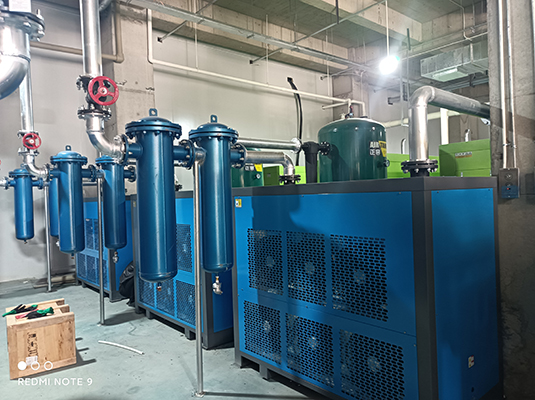
For textile mills, the compressor room must be integrated with air treatment, storage, and distribution networks. Permanent magnet units work effectively with dryers and filters to provide clean, dry air that protects valves, nozzles, and actuators across spinning, weaving, and finishing departments. Intelligent controllers enable remote monitoring, predictive maintenance scheduling, and energy reporting, helping managers identify leaks, pressure losses, and oversized equipment. Reduced wear on the PM motor and fewer mechanical losses translate into longer service intervals and lower maintenance costs, supporting stable operation of fabric processing machinery over the long term.
1、How does stable air pressure affect fabric quality?
Stable pressure keeps yarn tension and weft insertion consistent, reducing broken ends, mispicks, and weight variation, which directly improves uniformity, surface appearance, and overall fabric quality.
2、Why choose a permanent magnet compressor over a standard screw compressor?
A permanent magnet compressor offers higher efficiency at part load, better pressure control, lower energy consumption, and reduced operating noise, all of which are especially valuable in continuous textile production.
3、Is a permanent magnet compressor suitable for retrofit projects in existing mills?
Yes, it can be integrated into existing pipelines and air treatment systems, often replacing multiple older units and providing better control, lower energy use, and more stable air supply for current machinery.