fixed speed screw air compressor Energy Consumption Factors Often Overlooked
News 2025-12-22
Fixed speed screw air compressor Energy Consumption Factors Often Overlooked
Hidden impact of load profile and duty cycle
In many plants the air compressor runs at fixed speed around the clock, even though actual air demand fluctuates widely. This mismatch between compressor output and real consumption is one of the most overlooked drivers of energy waste. When a fixed speed screw unit repeatedly cycles between load and unload at low demand, it still consumes a large percentage of full‑load power while producing little usable air. Analysing load profile, duty cycle, and production schedules allows engineers to align compressor sizing, storage capacity, and control logic to real process needs in automotive workshops, electronics assembly lines, metal fabrication shops, and packaging facilities.
Role of system pressure, leaks, and distribution design
Plant managers frequently focus on compressor nameplate efficiency yet ignore downstream conditions that silently raise kWh per m³ of air. Excessive system pressure is a classic example: increasing pressure by just 1 bar can elevate energy consumption by roughly 7–8% while offering no added value to most pneumatic tools. Compressed air leaks in aging pipe networks, poorly sized headers, sharp bends, and undersized hoses all create pressure drop, prompting operators to raise setpoints. In continuous industrial processes such as textile mills or food and beverage plants, regular leak detection, looped piping layouts, and correctly sized filters and dryers can drastically reduce the energy burden on a fixed speed screw compressor.
Ambient conditions, cooling, and maintenance practices
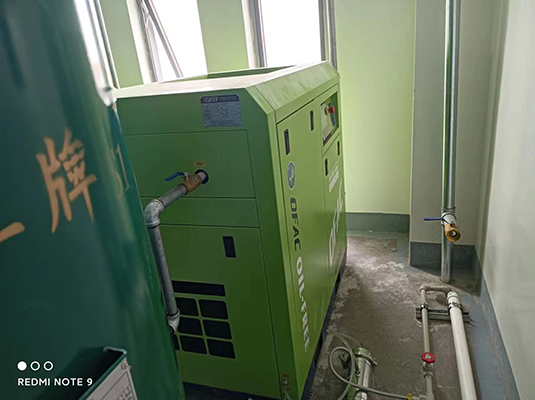
Energy performance is also shaped by how and where the compressor is installed. High ambient temperature, restricted ventilation, and clogged coolers force the package to work harder, raising input power and shortening component life. Dirty inlet filters and oil filters increase differential pressure and reduce volumetric efficiency. In dusty cement plants, woodworking shops, and mining operations, failure to adjust maintenance intervals to harsh conditions causes specific energy to creep upward year after year. A clean, well‑ventilated compressor room, scheduled cooler cleaning, and condition‑based filter replacement help preserve design efficiency and protect critical industrial processes from unplanned downtime.
Control strategy, storage, and integration into plant operations
Beyond hardware, the control philosophy applied to fixed speed screw air compressors strongly influences total energy use. Simple pressure band control may be adequate for small workshops but is rarely optimal in multi‑shift manufacturing, petrochemical sites, or pharmaceutical plants. Properly sized air receivers, cascaded pressure settings in multi‑compressor stations, and intelligent sequencing can minimise simultaneous unloading and reduce idle running hours. Integrating compressor control into the plant’s energy management system enables operators to coordinate air production with batch operations, cleaning cycles, and peak‑demand tariffs, turning compressed air from a static utility into a managed energy asset.
Focused questions and short answers
1How does load profile affect fixed speed compressor efficiency?
When actual demand is low, a fixed speed screw compressor spends more time unloaded, still drawing significant power while producing little air, which increases specific energy consumption.
2Why are leaks so critical in industrial compressed air systems?
Leaks waste compressed air that has already consumed energy, force higher system pressure to maintain tool performance, and cause fixed speed units to cycle more frequently, raising operating costs.
3What installation factors most influence energy use?
Key factors are ambient temperature, ventilation quality, cooler cleanliness, inlet filtration, and appropriate air receiver sizing, all of which impact compressor efficiency, reliability, and lifecycle energy cost.